VOL. 2 · AUGUST 2026
AI Solopreneur:
when one person runs like an organization
In the solo era, what matters isn’t the individual
it’s the execution system you build with AI and platforms.
Execution Intelligence for Asia’s Act-preneurs
Hello,
this is Action Brief : ASIA, the insight brief from the Underdogs Data Center.
This August’s core question: how is AI changing the way solopreneurs execute?
Solopreneurs are no longer just people working alone. Using AI, platforms, and automation, they are becoming a new kind of operator — defining the problem, building the product, connecting with customers, and designing their own revenue model.
Starting with Korea, this Action Brief : ASIA looks at Japan, Indonesia, and India to see how solopreneurs are growing into a new kind of founder in the AI era.
Today’s Action Brief in three lines
1. A solopreneur isn’t ‘someone who works alone’ but ‘someone who builds an execution system alone.’
■The point is turning individual capability into a repeatable business structure.
2. AI is widening the range of what one person can execute.
■Planning, production, marketing, customer care, operations — the scope one person can handle keeps expanding.
3. The core of developing AI solopreneurs is execution data.
■Disposition, execution, MVP building, and customer validation have to be managed with data to become a sustainable growth model.
1. Opening Brief
In the solo era, what matters is the execution system, not the individual
The way we found companies and work is widening from organization-centered to individual-centered. But the rise of solopreneurs isn’t simply more one-person firms or sole proprietors. The real shift is that individuals now have to find the problem, build the product, meet customers, and generate revenue themselves.
AI and automation tools are accelerating this. One person can now handle market research, content creation, MVP building, customer support, and marketing on their own. So the core of developing solopreneurs isn’t delivering more startup information — it’s building the execution system that turns an individual’s expertise, experience, and skills into a real business structure.
In this brief, cases from Korea, Japan, Indonesia, and India show how AI is changing the way solopreneurs execute.
2. Korea Signal
Korea: the rise of solopreneurs is linking to development grounded in ‘execution systems’ and ‘execution data’
In Korea, solopreneurs are emerging as a new kind of founder. The country’s one-person creative enterprises grew 26.7% from 2020 to 2023, reaching 1.163 million by 2023.
Time to market is shortening, too. First revenue arrives 2.6 months after launch on average, and 66.1% see it within three months. More individuals are entering the market and reading customer response on their own.
But more individual founders doesn’t automatically mean sustainable growth. Underdogs’ DOGS data shows solo founders’ strengths and gaps together. Compared with founders overall, solo founders scored higher on Action (21.8% → 29.2%) and Results-orientation (13.3% → 18.1%), but lower on Collaboration (40.9% → 34.9%) and Support (62.0% → 55.4%).
This shows solo founders are strong at trying quickly and checking results, but need to strengthen the structures that connect people, resources, and feedback to keep going.
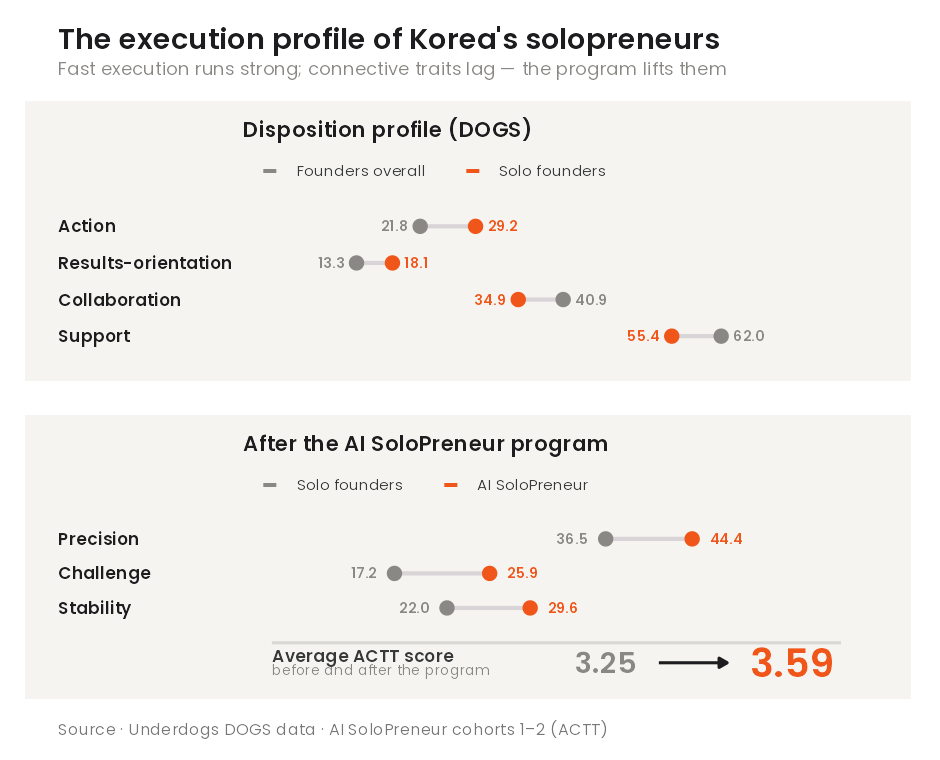
The AI SoloPreneur cohorts 1–2 show the same execution traits. Against solo founders overall, they scored higher on Precision (36.5% → 44.4%), Challenge (17.2% → 25.9%), and Stability (22.0% → 29.6%), and their average ACTT score rose from 3.25 to 3.59 after the program.
The data shows what AI solopreneurs need isn’t simply speed. It takes precision to review AI output, the willingness to try new approaches, and the stability to keep executing.
Action AI · when one person runs like an organization
Action AI, Underdogs’ solopreneur development program, shows how AI and no-code environments widen what one person can execute. The point isn’t Action AI itself, but that non-developers and beginners can turn ideas into finished work with AI.
In the end, the case shows more than a rise in individual startups. When execution disposition is diagnosed with data and the gaps in commercialization are filled with an AI-based execution environment, the solopreneur can grow into a sustainable Act-preneur.
Korea Point
■ The rise of solopreneurs is becoming a structural trend in Korea’s startup ecosystem.
■ Solo founders are high on Action and Results-orientation, but their connective structure needs work.
■ For AI solopreneurs, Precision, Challenge, and Stability stand out as key execution traits.
■ The Korean model turns on linking execution systems and execution data.
3. Japan Signal
Japan: solopreneurs who wire AI into their work are pulling ahead
Japan’s solopreneur ecosystem is splitting clearly by how deeply people use AI. In IT/Web, solopreneurs who use AI actively are lifting both productivity and earnings, while the broader solopreneur market and creative fields still can’t use AI fully.
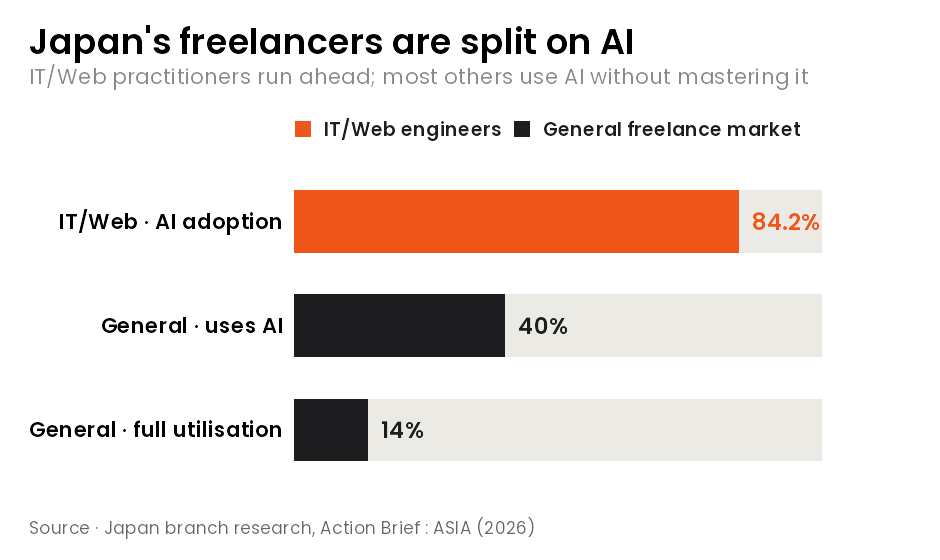
In IT/Web, solo engineers show an 84.2% AI adoption rate. Those who actively use tools like ChatGPT and GitHub Copilot raise both productivity and earnings; full-stack engineers using AI reach an average monthly contract rate around ¥901,000, with satisfaction as high as 89.3%.
In the wider solopreneur market, though, AI use hasn’t gone deep. About 40% use AI, but only 14% say they use it fully. Many use it without knowing how to apply it safely to real work. Security worries and a lack of practical, hands-on training are holding wider adoption back.
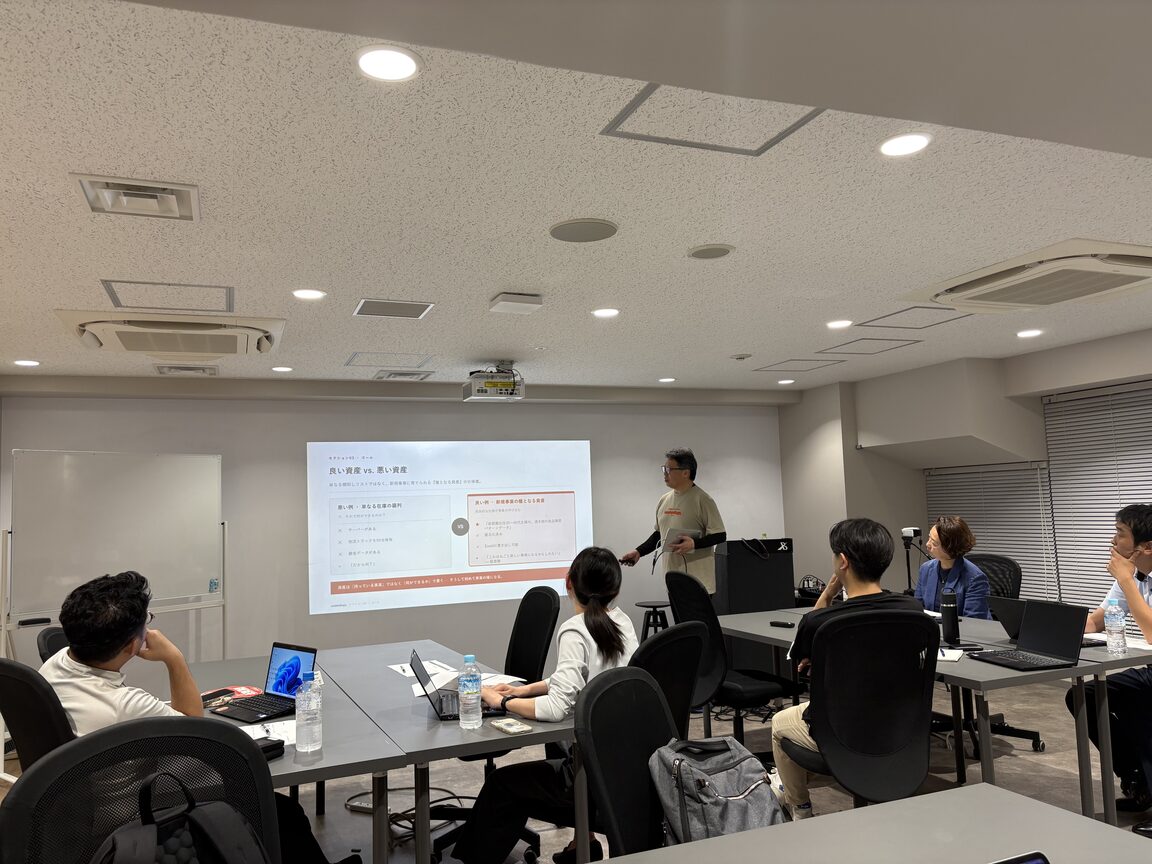
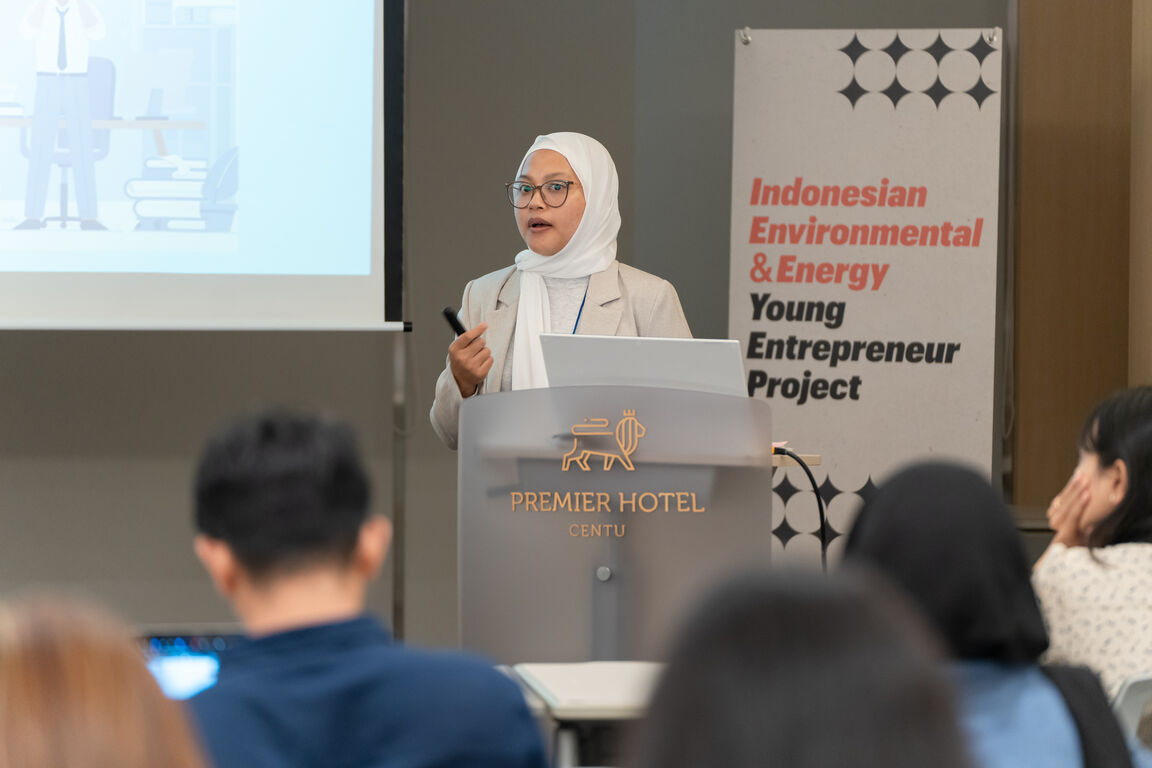
A workshop presentation in Japan
Creative fields face clear challenges too. In illustration, manga, and other creative work, AI is reshaping the market fast, and uncertainty over style imitation and copyright is growing. Along the way, 12% of creators saw income decline and 10.8% are diversifying their income.
In the end, Japan’s case isn’t about whether you’ve ‘tried’ AI. What separates solopreneurs’ results is whether they can wire AI into their actual workflow and revenue structure.
Japan Point
■ Japan’s solopreneur ecosystem shows a clear AI-utilization gap.
■ IT/Web wires AI into work, lifting productivity and earnings.
■ The general and creative segments still have gaps in the depth and stability of AI use.
■ Japan’s model turns on connecting AI use to work and revenue structure.
4. Indonesia Signal
Indonesia: AI adoption is fast, but the power to wire it into operations is still short
Indonesia is adopting AI fast. Adoption reaches 92%, but more than 90% of small-business operators still can’t use it well. In many cases AI stays a tool for finding ideas and never reaches daily operations.
What makes the difference is a system, not a tool. A Jakarta caterer didn’t adopt a new app — it wired cash-flow discipline, a growth plan, and AI into daily operations and doubled monthly revenue in three months. Firms that wire AI into operations are 1.8x more likely to grow revenue.
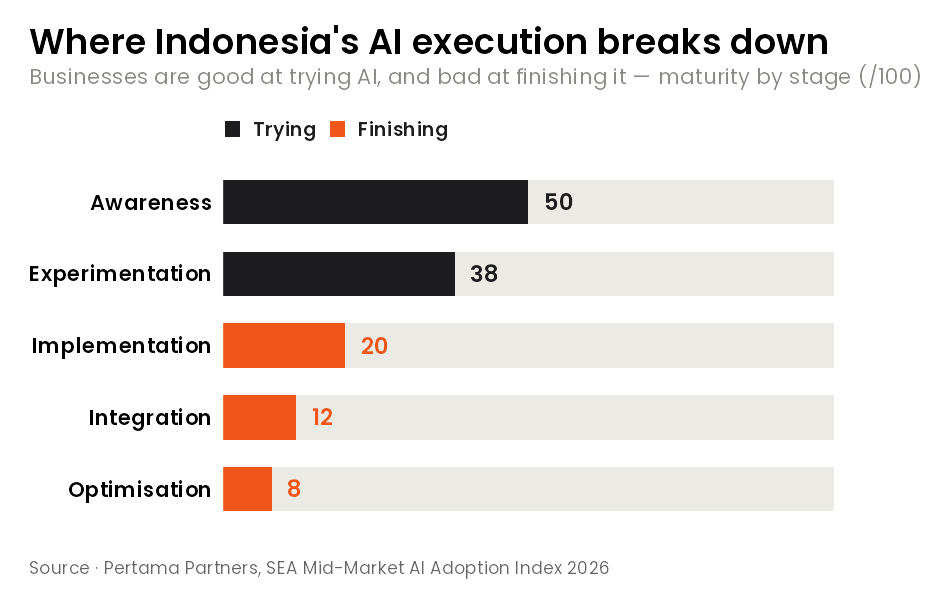
Stage by stage, the problem is clearer. Awareness and experimentation are high, but the scores fall sharply toward implementation, integration, and optimisation. Many try; few wire it all the way into operations.
Indonesia has more than 65 million small businesses employing about 120 million people and generating roughly 60% of GDP. Helping that base build an AI execution system can do more than simply spreading tools.
Indonesia Point
■ Adoption is 92%, but 90%+ can’t use it well.
■ What makes the difference is the execution system, not the tool.
■ Firms that wire AI into operations are 1.8x more likely to grow revenue.
■ The point is embedding AI into daily operations.
5. India Signal
India: micro-enterprises and shared AI infrastructure are becoming the base for solopreneurs
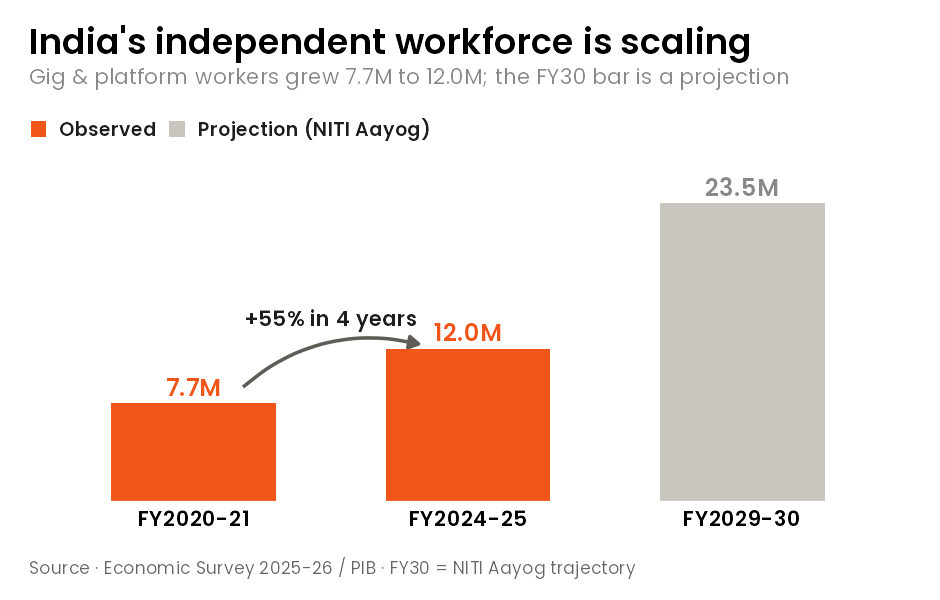
In India, working alone or in a small team is already a major economic force. Gig and platform workers grew 55%, from 7.7 million in 2021 to 12 million in 2025, and 60% of those employed in unincorporated businesses are working owners running their own operations.
The institutional base is expanding too. Udyam — India’s official government registration for micro, small and medium enterprises (MSMEs), giving them an official MSME identity and access to government schemes and support — now carries 90.76 million registrations, and 99.36% of classified enterprises are micro. On top of that, the IndiaAI Mission has opened more than 38,000 GPUs as shared compute and is widening access to open datasets and AI models.

The results show up on the ground. In a July 2026 MSME survey, 66% expanded market access through digital channels and 34% already use AI for content creation. PM Vishwakarma, Meesho, and SiteGPT show traditional artisans, platform sellers, and solo developers each building a solopreneur-style growth path.
India’s signal is clear. With shared AI infrastructure and platforms, one person or a very small team can execute like a company.
India Point
■ Gig and platform workers grew 55% in four years.
■ 99.36% of Udyam-registered enterprises are micro.
■ IndiaAI has opened 38,000+ GPUs as shared infrastructure.
■ The point is an environment where one person executes like a company.
6. From Brief to Action
Developing AI solopreneurs has to move from teaching to an execution operating system
What the cases from Korea, Japan, Indonesia, and India share is clear. AI and platforms are opening an environment where one person can build, sell, and experiment faster. But using tools alone doesn’t complete growth.
What matters is turning an individual’s expertise, experience, and sense of the problem into a real business structure. When problem definition, productization, MVP building, customer validation, and iteration connect into one flow, a solopreneur can grow into a sustainable operator.
So startup support should shift its measure from ‘how much did we teach’ to ‘how much execution structure did we build.’ Developing solopreneurs in the AI era means designing an execution operating system a person can use to start, build, validate, and improve on their own.
✓ This month’s Action Guide
Check your own execution system
This month, we suggest checking your own execution system from a solopreneur’s view. More important than having an idea is whether that idea is organized into a product customers can understand.
More important than how many AI tools you use is where AI sits in your execution process.
Action Checklist
■ What problem am I trying to solve?
■ Is my idea organized into a product customers can understand?
■ Which of production, marketing, or customer care am I reducing with AI?
■ Do I have a routine that turns customer response into the next action?
✓ Action Lab
This brief’s questions lead into real execution projects
Through Action Seminars, webinars, and Underdogs’ field programs, extend the signals of change into concrete execution.
▶ July Action Seminar review — ‘The solo era: a solopreneur execution strategy’
✓ Next Brief
September: the execution code that turns entrepreneurial talent into results
September’s Action Brief takes up entrepreneurial talent people who don’t stop at carrying out assigned work but find problems, judge for themselves, and create new organizational value through execution, learning, and expansion. We’ll look at how their execution code connects to results in an industrial era being reshaped by AI.
Action Brief : ASIA will read Asia’s changes each month through an operator’s lens and, grounded in the Underdogs Data Center’s research and field data, offer a benchmark for your next move.
Beyond startups, into organizations and daily life.
Beyond Korea, into Asia.
Each month we read Asia’s changes through an operator’s lens
and, grounded in the Underdogs Data Center’s research and field data,
share a benchmark for your next move.
Action Brief : ASIA
Execution Intelligence for Asia’s Act-preneurs