In the Era of National Entrepreneurship, Seeking Local Startup Strategies to Nurture Regional Youth
2026-02-25
|
The Butter
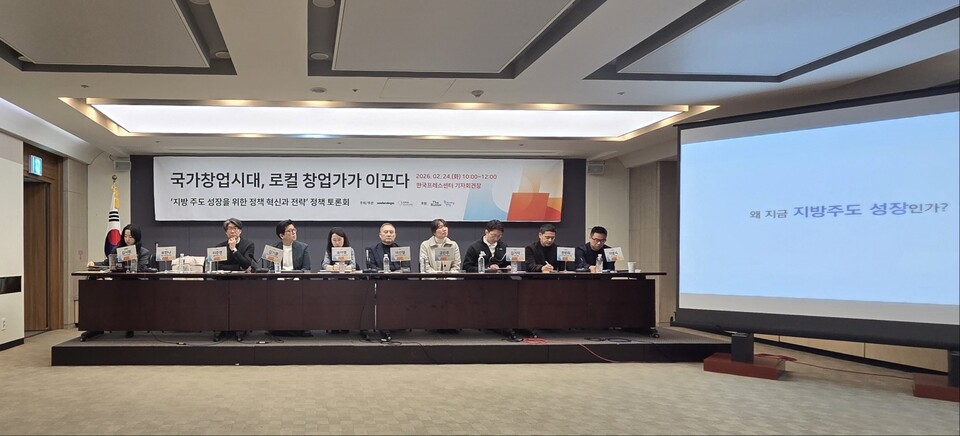
In response to the national entrepreneurship era, a policy discussion forum was held to discuss local startup strategies and youth talent development plans to drive region-led growth. UD Impact and the Korean Institute for Social Value Assessment hosted a policy discussion forum on the 24th at the Korea Press Center in Jung-gu, Seoul, with the theme "National Entrepreneurship Era, Led by Local Entrepreneurs." The Butter and Creating a Better World Together participated as sponsors, with approximately 80 attendees including local government officials, public institution policy managers, and local startup sector professionals. The discussion forum, co-hosted by UD Impact and the Korean Institute for Social Value Assessment, focused on examining implementation strategies to support region-led growth within the policy trend of positioning entrepreneurship as a key driver of national growth, and seeking ways to establish regions as subjects of entrepreneurship and innovation rather than merely as recipients of support. Kim Si-won, CEO of The Butter and moderator of the forum, stated in his opening remarks that "after various trial and error in solving regional imbalance and population decline issues, local startup and regional youth talent support have begun to receive attention as solutions," and "as the national entrepreneurship era and region-led growth direction align, the importance of regions as spaces where entrepreneurship actually takes place is increasingly growing." He continued, "In today's discussion forum, we will discuss how to effectively connect policy and practice, and concrete strategies for nurturing regional talent." Essential Conditions for "Region-Led Growth" The first session topic was "The Role of Policy and Transformation of Value Evaluation Systems for Talent Development in the Local Era." Speakers provided a broad framework for policy strategies to nurture regional talent and evaluation systems to properly measure and reward the results of local startups. Yu Han-na, member of the Committee for the Local Era, presented on "The Importance of Region-Led Growth through Innovative Talent Development." Member Yu characterized Korea as still a "capital-centric republic" and explained that this results in talent drain from regions, companies avoiding the areas, tax revenue decreasing, and infrastructure and services deteriorating. She also stated, "The greatest problem is the lack of capacity within regions to design growth engines and potential," adding that "the core of such capacity ultimately comes from 'people.'" According to Member Yu, the government is pursuing various policies to build a "regional talent development ecosystem." It strengthens R&D capabilities centered on national universities in regions and reinforces startups closely related to local industries. It also implements tech and local startup activation policies in line with the "national entrepreneurship era" direction. The plan is to discover 5,000 startup talents by 2030 and nurture 10 global hub cities. Member Yu emphasized, "To foster innovative entrepreneurs in regions, we need intermediate support organizations, financial experts, and public planning personnel to develop them." Professor Ra June-young of Catholic University explained the strategy for building a local startup ecosystem under the theme "How Should the Performance of Local Startups Be Understood," using evolutionary principles as an analogy. Professor Ra explained that the following are necessary: ▶︎New business models and technologies continuously flow into regions (mutation) ▶︎Private selection functions operate in product and capital markets (selection) ▶︎Successful models spread in ways tailored to each region's characteristics (replication) ▶︎A structure where diverse actors including entrepreneurs, intermediate support organizations, and financial institutions evolve together through competition and cooperation (co-evolution). To achieve this, he stated, "Rather than directly screening and supporting individual companies, the government should promote private capital inflow through patient capital and blended finance, and establish impact performance-based evaluation and compensation systems in public procurement and outsourcing to create markets where local companies can grow." He continued, "Beyond business-expense-centered support, we need to expand investments in people and organizations (including operating and indirect expenses), and strengthen the ecosystem's implementation capacity through role transformation of regional financial institutions and capacity strengthening of intermediate support organizations." Kim Ki-ryong, CEO of the Korean Institute for Social Value Assessment, explained "The Necessity of Measuring Local Startup Impact," stating that "measurement is not merely evaluation, but a tool that promotes innovation." According to CEO Kim, the most important aspect of impact measurement is not creating a "list of indicators," but confirming how a business model contributed to solving social problems in the region. CEO Kim said, "The measurement process should redefine what social problems the business is trying to solve," and warned that "if measurement is not properly conducted, projects that greatly contribute to solving social problems can be undervalued." He emphasized, "Through accurate measurement, organizations should clarify the problems they are actually solving, and national support and investment should be based on those results." Local Startup Solutions Through Case Studies In the second session, various case presentations were made under the theme "Sustainable Local Entrepreneur Development Strategy to Strengthen Regional Self-Sufficiency." Song Ah-young, Local Startup Leader at UD Impact, shared UD Impact's development cases and achievements under the theme "Local Entrepreneurship Creating Solidarity and Relationships." UD Impact's local entrepreneur development types are divided into six major categories: ▶︎University collaboration model ▶︎Local government major project linkage model ▶︎Regional settlement-type entrepreneur development model combining private capital ▶︎Major city youth regional matching and dispatch model ▶︎Talent development model for regions facing population extinction crisis ▶︎Local small business owner startup support model, etc. Leader Song stated, "While traditional entrepreneurship focused on individual company survival and sales growth, local entrepreneurship should make solidarity and cooperation the foundation and core driver of business," adding that "to build trust between stakeholders, long-term ecosystem-building projects are needed rather than immediate results." Lee Seon-cheol, CEO of "Potato Flower Studio," a complex cultural space operated in Pyeongchang, Gangwon-do for 17 years, discussed "How are local entrepreneurs creating sustainable models." CEO Lee discussed various programs including festivals, performances, exhibitions, and resident education implemented in this remodeled small abandoned school building.