Korea-Japan Local Players Draw the Future of Their Regions Together
2025-11-18
|
The Butter
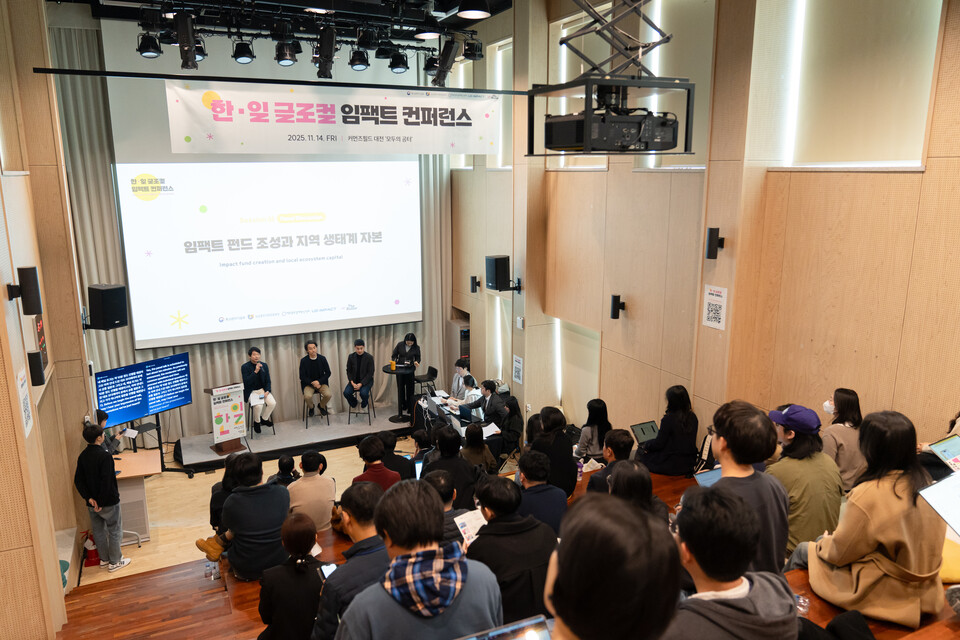
Local players from Korea and Japan who are thinking about sustainable regional innovation gathered in one place. The '2025 Korea-Japan Glocal Impact Conference' was held on the 14th at the Commons Field Commons Square in Daejeon. Jointly hosted by UD Impact, the Ministry of SMEs and Startups, the Small Business Market Promotion Agency, and the Jeju Creative Economy Innovation Center, with The Butter participating as a media partner, the event was held under the theme 'Border-Less Local – Going Beyond Boundaries, Sustainable Glocal Cooperation.' UD Impact is a global ESG comprehensive solution company that has continued various experiments and collaborations over the past decade at local startup sites across the country, based on the principle that 'regional change begins within the field and through mutual connections.' The conference was organized to share these on-site experiences and establish an official network among local stakeholders from Korea and Japan. The event was attended by approximately 80 participants including entrepreneurs, investors, and public and private experts from Korea and Japan. They jointly explored response measures to the common challenges of 'population decline' and 'regional extinction' that both Korea and Japan face. At the '2025 Korea-Japan Glocal Impact Conference' held at the Commons Field Commons Square in Daejeon on the 14th, approximately 60 entrepreneurs, investors, and public and private experts from Korea and Japan attended. [Photo: UD Impact] Mi-ae Hwang, standing director of the Small Business Market Promotion Agency, said in her remarks, "Korea and Japan have different histories and cultures, but share the same concern about 'creating a new future through the unique assets and people of regions.' I hope this conference will not be a one-time event but will serve as a foundation for sustainable cooperation." Lee Chung-soo, an official at the Ministry of SMEs and Startups who gave the keynote speech, said, "Local policy is ultimately a talent development policy. The results of urban regeneration and cultural city projects are not visible facilities, but the talented people and business operators who grew in the process." He added, "The Ministry of SMEs and Startups will continue to pursue policies that cultivate talented individuals to develop small regional brands and support them to remain as meaningful regional brands or grow into businesses." The event was held in four sessions. In each session, discussions centered on ▶Impact investment ▶Regional branding ▶Global network expansion ▶Local brand results. The first session was held on the theme 'Impact Investment and New Models of Regional Ecosystem Capital.' Mitsuaki Aoyagi, executive director of Japan's Social Innovation Investment Foundation (SIIF), who gave the keynote speech, presented on the theme 'How startups have the power to change regions.' He introduced cases of impact investment in Japan, explaining how capital becomes a new driving force for solving regional problems. Director Aoyagi said, "Japan and Korea are facing similar issues such as aging populations, population decline, and weakening regional identity. To solve these structural challenges, it is essential to have a structure where region-based companies create and expand their own businesses." He emphasized this point. Mitsuaki Aoyagi, executive director of Japan's Social Innovation Investment Foundation (SIIF), is presenting on the theme 'How startups have the power to change regions.' [Photo: UD Impact] The presentation introduced various regional impact investment models in Japan, including the case of A0 Group in Okayama Prefecture leading regional regeneration by expanding business from forestry and agriculture to care services using natural resources, the way the 'Yamato Social Impact Fund' in Nara Prefecture sets investment directions by analyzing problem structures, and the 'Cali Impact Innovation Fund' created through direct investment by Okinawa residents. He said, "Impact investment is evolving beyond profit to become capital of trust that transforms regions. To create a sustainable ecosystem in regions, structural cooperation involving entrepreneurs, financial institutions, local governments, universities, and nonprofits is necessary." Han Wan-hee, CEO of Newkids Investment, then presented an impact investment model targeting local businesses and small merchants from the perspective of an entrepreneur-turned-investor. He said, "While there is still much skepticism about the possibility of returns in local investment, Newkids Investment is creating new success equations by identifying strong small merchants and expandable local brands, and through investment by senior entrepreneurs, acceleration, and platforms that can collect data." Yoshitaka Tabuchi, co-representative of Zebra & Company, the second speaker, pointed out the importance of companies with long-term and multi-stakeholder perspectives, going beyond unicorn models that pursue only rapid growth. He said, "If we only use exponential growth as a standard, many social enterprises are excluded from investment targets." Yoshitaka Tabuchi, co-representative of Zebra & Company. [Photo: UD Impact] A panel discussion was held on the topic 'Impact Fund Formation and Regional Ecosystem Capital.' The speakers discussed the most difficult points in impact investment and important factors to consider in the actual investment process. Han Wan-hee said, "Impact measurement doesn't end at creating numbers; it's important to consider how that data translates into actual effects in reality. We also examine the entrepreneur's perspective, authenticity, and intentions." Tabuchi said, "Solving social problems requires a long time, but most funds require recovery within 5-7 years. The impact ecosystem needs 'long-term capital,'" he emphasized. The second session's theme was the strategy of regional branding and space planning. Professor Ma Kang-rae from Chung-Ang University's Department of Urban Planning and Real Estate gave a presentation on the theme 'Conditions for regions to become laboratories for local business growth,' pointing out the regional disparities and lack of ecosystems that Korea and Japan commonly face. He said, "The concept of 'ecosystem' that frequently appears in regional development discussions is being consumed abstractly. It should be a priority to imagine specific systems that regions can actually use to develop companies." To explain this, he cited the example of Germany's 'Hidden Champions,' which refers to strong small and medium-sized enterprises, saying, "The fact that world-class companies could be established in cities with populations of less than 20,000 was because there was an ecosystem in the region that nurtured internal companies." (From left) Ma...